There is a part of the last post that I omitted and didn’t realize it until the next morning. I talked about how we need wildness to help us stay connected to reality and acquire true experience. I also talked about how we can find this National Parks but I did not spend enough time talking about the miracle of the national park service. I want to talk for a little bit about the challenges of the NPS and some of my favorite people in the history of the National Parks.
I have a huge list of people that I want to talk about but it would take the rest of the year. So I am going to start with a small group. Just fifteen people, they came from a wide range of back grounds and ideologies. With the current political climate the way it is, I thought it would be interesting to reference some people that earned the trust and respect of people for decisions that were principled and true but unpopular, sometimes violently unpopular.
Here is the list:
- Abraham Lincoln, 12 February 1809 – 15 April 1865
- Andrew Jackson Downing, 31 October 1815 – 28 July 1852
- Calvert Vaux, 20 December 1824 – 19 November 1895
- Frederick Law Olmstead, 26 April 1822 – 28 August 1903
- Ulysses S. Grant, 27 April 1822 – 23 July 1885
- John Muir, 21 April 1838 – 24 December 1914
- Theodore Roosevelt, 27 Oct 1858 – 6 January 1919
- General Philip Sheridan, 6 March 1831 – 5 August 1888
- Stephen Mather, 4 July 1867 – 6 May 1930
- Horace Albright, 6 January 1890 – 28 March 1987
- John Rockefeller Jr., 29 January 1874 – 11 May 1960
- George Melendez Wright, 20 June 1904 – 25 Feb 1936
- Olaus Murie, 1 March 1889 – 21 October 1963
- Adolf Murie, 6 Sep 1899 – 16 Aug 1974
- Stewart Udall, 31 January 1920 – 20 March 2010
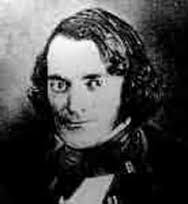
Andrew Jackson Downing, Calvert Vaux and Frederick Law Olmstead are the men largely responsible for Central Park in New York City. In the early 1800s Central Park was a disaster. Not as great a disaster as Niagara Falls but close and in a different way. Niagara had been defiled. Developers had turned it into the worst kind of carnival and made it impossible to enjoy the falls as The Falls 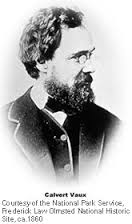 themselves. With this in mind the city council of New York looked with trepidation at Central Park. At the time it was simply an empty space in the city. Filled only with Vandalism, graffiti and garbage.
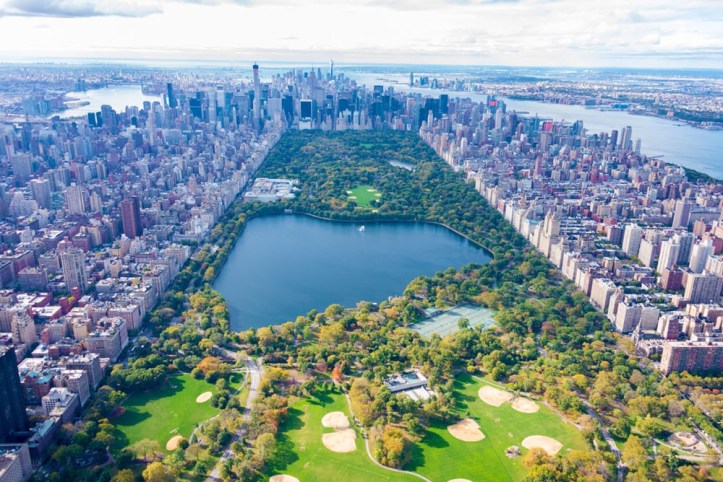
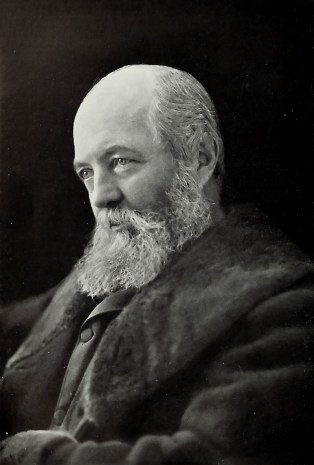
Downing and Vaux built an architectural firm that was a huge departure from standard practices of the day. Downing died early (at 36) in a riverboat fire. A little while later Vaux joined with Frederick Olmstead and the entered the Greensward plan to the competition for Central Park. It took decades to finish but the result is incomparable. The real estate value has been estimated at between 35 and over 500 billion dollars. For a huge number of factors this is impossible to guess accurately. But, it’s kind of irrelevant.
Developing Central Park into any kind of buildings would be catastrophic. Everyone knows it, they feel it deeply and even if they can’t pin down why, they know it would be wrong. The success of Central Park was clear evidence that was used over and over in the fight to preserve open, green and wild places for rejuvenation. It was the first large step towards creating a National Park System.
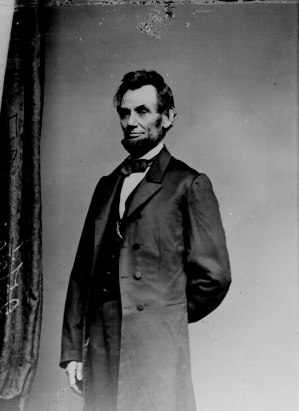
Lincoln wasn’t known for his conservation ethics but story after story from his youth showed a deep love for nature and wild things. Although he never visited the place on 30 June 1864 he set aside the Mariposa grove and the Yosemite valley as federally protected lands. He would be killed a little less than a year later. The Arkansas Territorial Legislature tried in 1820 to get the federal government to protect the hot springs and the surrounding mountains but nothing came of it until 1832 and then it included only the thermal features. Also four years later President Grant set aside land in Alaska to protect the Northern Fur Seal. To me, Lincoln’s move stands out because it was to protect beautiful places, not profitable ones.

I have already mentioned Ulysses S. Grant’s move to protect the Fur Seal in Alaska, which was only a year after we bought the place. The reason he makes this list on his own is that he designated Yellowstone as a National Park. The first ever in the entire world. The importance of this cannot be overstated. Yellowstone was on the edge of being overrun and it was in all business and political interest to let them do so. Grant saw beyond the next twenty years and made the right choice. And we are so very glad that he did. I have traveled a great deal of the world and studied much more and there is no place like Yellowstone.
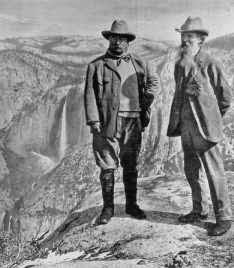
John Muir and Teddy Roosevelt should be talked about at the same time here because of how intertwined their paths were. But so much should be said about each of them that they will each get their own space.
Muir was a Scottish immigrant who came to America for the purest of reasons. There was still wildness here. It took him a while to get there but when he got to California and was introduced to what is now the Yosemite area, he never really left. He would travel to Alaska and a few different parts of the west but would always return to his Cathedral in the Sierras.
Early on Muir was part of the razing of the valley. He helped with the sawmill in the valley. Can you imagine a sawmill running in Yosemite Valley? But it was a necessity job and he didn’t keep it for long. He loved the wild too much. He would wander the mountains, climb trees in storms, hang off the edge of cliffs and sit for hours listening to the voices of the streams and leaves.
When he saw this most precious valley being laid bare he started working to protect it. 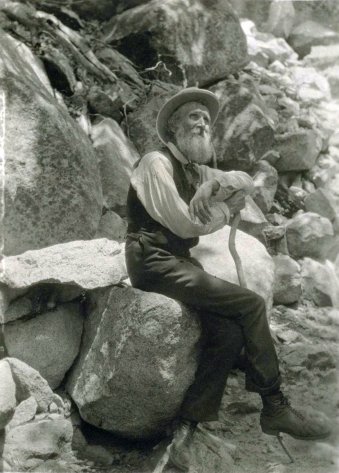 He wrote articles to papers and worked himself sick to try to protect the area in a way that no one else seemed to care about. Then Teddy showed up and Muir effectively kidnapped him (although Roosevelt went rather willingly) and poured his soul into the President. It worked, when Teddy returned to D.C. he set to with a will. He created 5 National Parks and 69 other conservation sites.
Muir stayed mostly in California, fighting against the colonization of Yosemite and the building of a dam in Hetch Hetchy Valley, a neighbor to Yosemite. Ultimately the dam was built in Hetch Hetchy and you can decide for yourself if the buildings in the Yosemite valley are an improvement on what eons have built. Giving the NPS a home in the heart of the park seems to be a good thing but it was not without a cost.
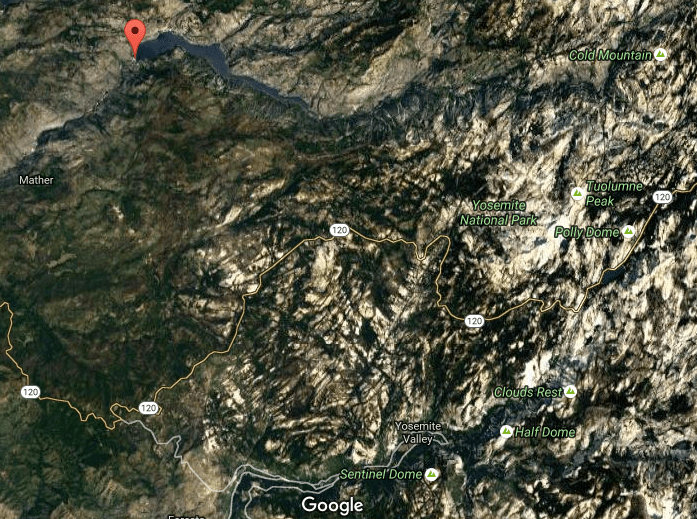
Muir’s cause of death was officially Pneumonia but it happened one year and five days after the Baker Bill authorizing the Hetch Hetchy dam was signed by Woodrow Wilson in 1913. He had fought harder and longer than anyone could be expected to fight. When he and his friends lost, there was a relief of not having to fight anymore and a release of responsibility that led to his death.
John Muir is one of the most inspiring figures in history. He lived so purely that even his enemies felt the power of his spirit. He also followed a path to truth that is increasingly unpopular. He would feel a thing, know of it’s truth and then move to find the proof for it. In today’s evidence-saturated world people scoff at anyone who uses this approach, calling them close-minded and dogmatic. But truth is truth whatever it’s source and in the words of Hub McCann:
“Sometimes the things that may or may not be true are the things that a man needs to believe in the most. That people are basically good. That honor, courage and virtue mean everything; that power and money … money and power mean nothing. That good always triumphs over evil. And I want you to remember this… that love… true love never dies! Remember that, boy … remember that. Doesn’t matter if it’s true or not, a man should believe in those things, because those are the things worth believing in.
John did not let himself be distracted or bothered by rules such as these. He refused to ignore the intuition that had served him so well. He knew that some things are right. He felt them and he lived his life according to that rightness as well as he could. I think he was one of the least hypocritical people that have lived. He was not perfect and his failures cankered his soul and were big enough that he knew we would still be reeling from the impact generations later.
Theodore Roosevelt was rightly called a Force of Nature. He was unstoppable. While 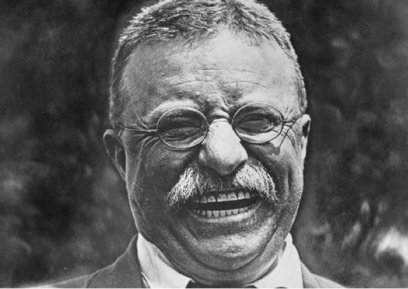 young he was constantly sick and advised not to do the things he wished to. He ignored them and hiked until he was strong. He was the youngest person elected to the New York State Senate and turned the entire group on it’s head. He kept a menagerie in his dorm room at Colombia. He organized a volunteer group of soldiers
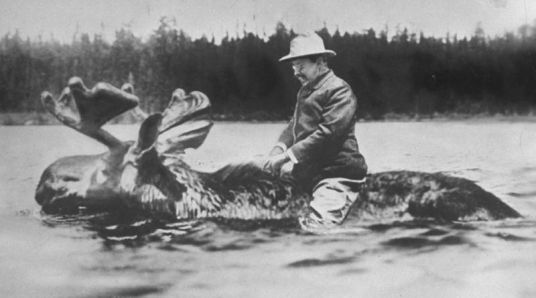
into the legendary Rough Riders which played a critical role in the war in Cuba. He made National Parks with the stroke of his pen when he knew they needed to be made and no one else would do it. And my personal favorite; He was preparing for a campaign speech and was shot in the chest. No worries, he finished the speech anyway. It is clearly impossible to quantify the impact Theodore Roosevelt had on the country. He set the precedent for so many great things that we now take for granted. In the Pantheon of American Presidents he is one of the true greats.

General Sheridan’s story is a simple one as it connects to the National Parks. He had spent his career fighting in the Civil war and against the natives, clearing a place for the settlers that were to come. He was the commander of the western armies and took up the cause of Yellowstone when it became painfully obvious that the government, although making the place a park in 1872, had no plan to take care of the park. Their plan, in fact was to commercialize the whole place. Giving 4,000 acres to developers, putting railroads straight into the park and giving leases out for the areas immediately next to the primary attractions.
Sheridan would have none of it. He went and lobbied directly in the face of the railroad barons, some of the most influential people of the era. He continued that grand tradition of kidnapping willing victims to educate decision makers about the issues they were about to botch. He took President Chester Arthur out to see the place that was causing such a ruckus. Ironically they traveled until Green River, Wyoming on the railroads. Sheridan’s proposals were to keep the railroad out of the park completely and keep the areas around the main attractions free. He also demanded that the developers be only given 10 acres instead of the 4,000 they wanted.
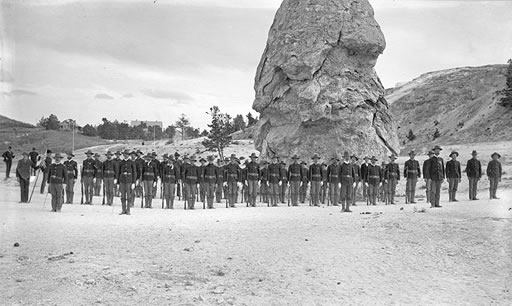
He got nearly everything he asked for. He was denied in his request for park expansion but the rider on the law granted everything else. But when he returned to Yellowstone it didn’t seem to matter because the Superintendents were either incompetent or railroad crooks. So again he took matters into his own hands. He moved in with his cavalry and managed the park with possibly the most righteous martial law ever. They stayed for 30 years. The finally felt comfortable leaving when the Park was transferred back to the jurisdiction of the Dept of the Interior when the National Park Service was formed with Stephen Mather at it’s head.
Stephen Mather was a true shooting star. He went big on every endeavor. He started in the borax business making a fortune harvesting the element from Death Valley, now another National Park. He was a man driven almost pathologically on the paths he 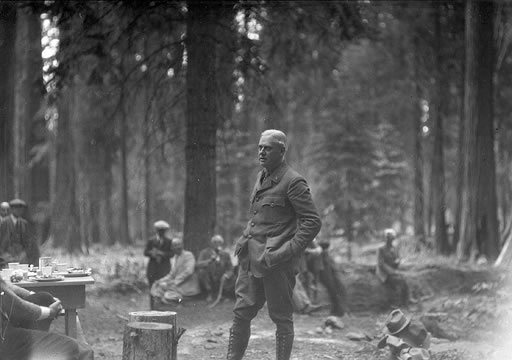 chose. He connected with friend in Washington D.C., concerned about the management of the newly minted National Parks. He told the government they were doing a terrible job to which they responded “Do it yourself” So he did.
He spent hundreds of thousands, maybe millions of dollars of his own money to refine and improve the National Park Service. He began training the rangers and hand-selected Superintendents so that he could be comfortable that the parks were in good hands. For the first time the National Parks had a governing body that was 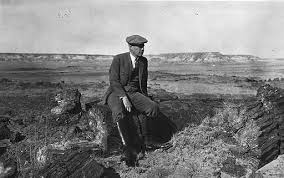 interested only in their well-being. Stephen Tying Mather threw himself heart and soul into his work. It wasn’t until later in his life that we began to see why he was so fanatically passionate about the preservation of wild places.
Stephen Mather was deeply troubled. He suffered crippling anxiety attacks. He would go down for months at a time, once for a couple of years. One of the only treatments that really works was spending time in his beloved parks. I think he sensed that the loss of the wild places would mean the end of mental health on a national scale. So he fought to the end. In 1929 a stroke cut off his career and he died shortly after. Nearly every Park has a location named after him and every National Park has a plaque with his name and face. The inscription on these plaques ends with… “There will never come an end to the good he has done.”
Horace Albright was Stephen Mather’s right hand man and successor. Mather was the right person to bring up the NPS in the frontier of the early 1900’s. His wild approach 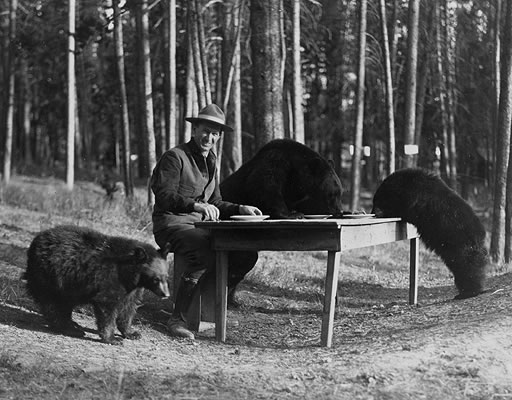 to management was exactly what was needed. But as the NPS matured along with the American political system it became more difficult to act in such a cavalier way. A gentler more precise touch was needed, enter Horace Albright.
Albright worked with business’ and politicians to cement the space the new Park Service had just barely grown into. The mission of the NPS reads thus:
The National park Service preserves unimpaired the natural and cultural resources and values of the national park system for the enjoyment, education, and inspiration of this and future generations.
The tricky part is the “enjoyment of this and future generations.” Enjoyment typically means, and certainly meant even more so back then, a certain amount of using up. This makes it impossible to preserve the place for future generation to enjoy in the same way as did the early users. That is the line that the NPS has walked their entire existence. Above, Albright is eating dinner with a few bears as company. This was not uncommon for a while in Yellowstone. It was seen as one of the attractions. But I think all thoughtful people gradually began to see the problems with this practice. Albright certainly did and under his watch the circus style interaction at the Parks began to decline. Now the NPS has tightened their systems to the point that they have a clear idea of how to use and enjoy while at the same time preserving and protecting for the future.
We have all see pictures of the Teton Mountain range. Usually with a old barn in the 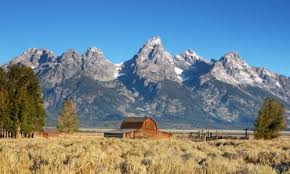 foreground like this one has. The wide open valley in front of the Tetons, the jeweled necklace of lakes and the rivers and streams would all have hotels and resorts choking them out had it not been for John D. Rockefeller spending a great deal of his fathers oil
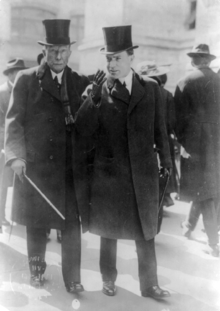
money. After John Sr. (who was also a serious philanthropist, just not a conservationist) let the money and control pass to his successors and kids (this was about the same time that Standard oil was broken up into over thirty different companies. Of these came: Exxon, Mobil, Amoco and Chevron among many others.
John Jr. chose a different path from his father. He worked the banking industry but saw the fledgling NPS as a worthy recipient of the financial might of his family. He would buy property and donate it to the NPS. He did this for a few different Parks. Some of the crown jewels in fact: The Tetons, Shenandoah, Great Smoky, Yellowstone and Acadia. Occasionally he would have to hide his identity behind dummy corporations so that the sellers wouldn’t realize that a Rockefeller was involved and raise the prices. It is hard to imagine what the Tetons would be like without the valley to frame the peaks. Finally a high-level banker who did the right thing.
In 1927 The National Parks were hitting their stride. It was between the two Great Wars and America was feeling the reality of her incredible strength. Eminent Domain was still popular in ways that caused a great deal of damage. In the parks this translated into vicious treatment of predators. It was customary for wolves, bears and other pest animals to be shot without a reason or provocation. No one saw any real reason that this was wrong until three scientists gave their lives over to the study of environmental balance and saw the whole picture for the first time.
George Melendez Wright was a budding a driven scientist who had been orphaned at 8 years old. He grew to love the natural world and with an inheritance from his mother’s El Salvadorian family 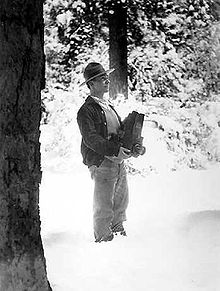 funded his own research on the value of certain Faunas in the Yosemite Ecosystem. His work began the change the perception of animal interaction on the west coast. Tragically, he died in a car accident in 1936 when he was only 31. But the door was opened to never be shut again.
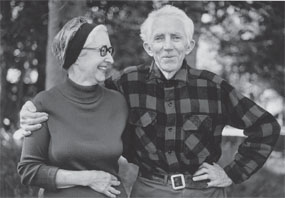
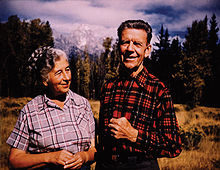
Born earlier and living longer than George Wright, the Murie brothers, Olaus and Adolf did some very similar work in Yellowstone and Denali National Parks. Around 1926 wolves had been completely removed from Yellowstone and the surrounding areas. They had been hunted for pelts and sport and the few who escaped the hunters fled. These two brothers studied the fauna balance and came solidly to the same conclusion that Aldo Leopold would come to write in “Thinking Like a Mountain.”
I now suspect that just as a deer herd lives in mortal fear of it’s wolves, so does a mountain live in mortal fear of it’s deer.
Wolves cut out the sick, weak and old. Human hunters go for the biggest. The natural selection process of the wolves leads to balanced, manageable healthy herd while the absence of wolves and the resulting hunting management by hunters leads to Depredation permits. Depredation actually means attack or plundering. Without wolves the cervid population grows too numerous and plunders the mountainside. Then we are forced to plunder the herds. Plundering is damaging to the soul and so we create this cycle that erodes our morality. It seems so obvious now but it took some very aggressive, forward-thinking and brilliant men to bring the truth to the forefronts of our minds.
The last person on the list is a straight up politician. Stewart Udall was elected to the House of Representatives in Arizona in 1954 and then became the Secretary of the
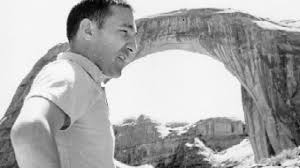
Interior from ’61 to ’69. This is where he became a conservation powerhouse. Here is an excerpt from his Wikipedia page.
Among his accomplishments, Udall oversaw the addition of four national parks, six national monuments, eight national seashores and lakeshores, nine national recreation areas, twenty national historic sites, and fifty-six national wildlife refuges, including Canyonlands National Park in Utah, North Cascades National Park in Washington, Redwood National Park in California, the Great Swamp National Wildlife Refuge in New Jersey, and the Appalachian National Scenic Trail stretching from Georgia to Maine.
Stewart Udall fought in World War II on a B-24 liberator in the European theater. As he went into politics in the ’50s he saw the general push towards the National Parks and the love and attention they were receiving. He did his best to carry them through this new trial. This was a new threat to wildness. Biophobia had been replaced by biophilia. It was just as threatening and under Udall’s careful guidance the NPS has emerged into the face of one of the best things that has happened in government.
We would likely have the National Parks and the Service that cares for them without these people. But I can say with some certainty that it would have taken much longer and would not look the same.
There is a interesting common factor in all of these people. Some were considered “Mushy-headed flower children” at the time (and probably still are by some today). Some looked like bullies in their single-minded approach to their goals. But their goals were to create and protect wild, fragile and beautiful places. It is easy to second guess and criticize their decisions or methods but history has vindicated them all. Had they not acted with such unhesitating focus we would not be the benefactors of the greatest natural treasures on the planet.
 Wilde Feathers